
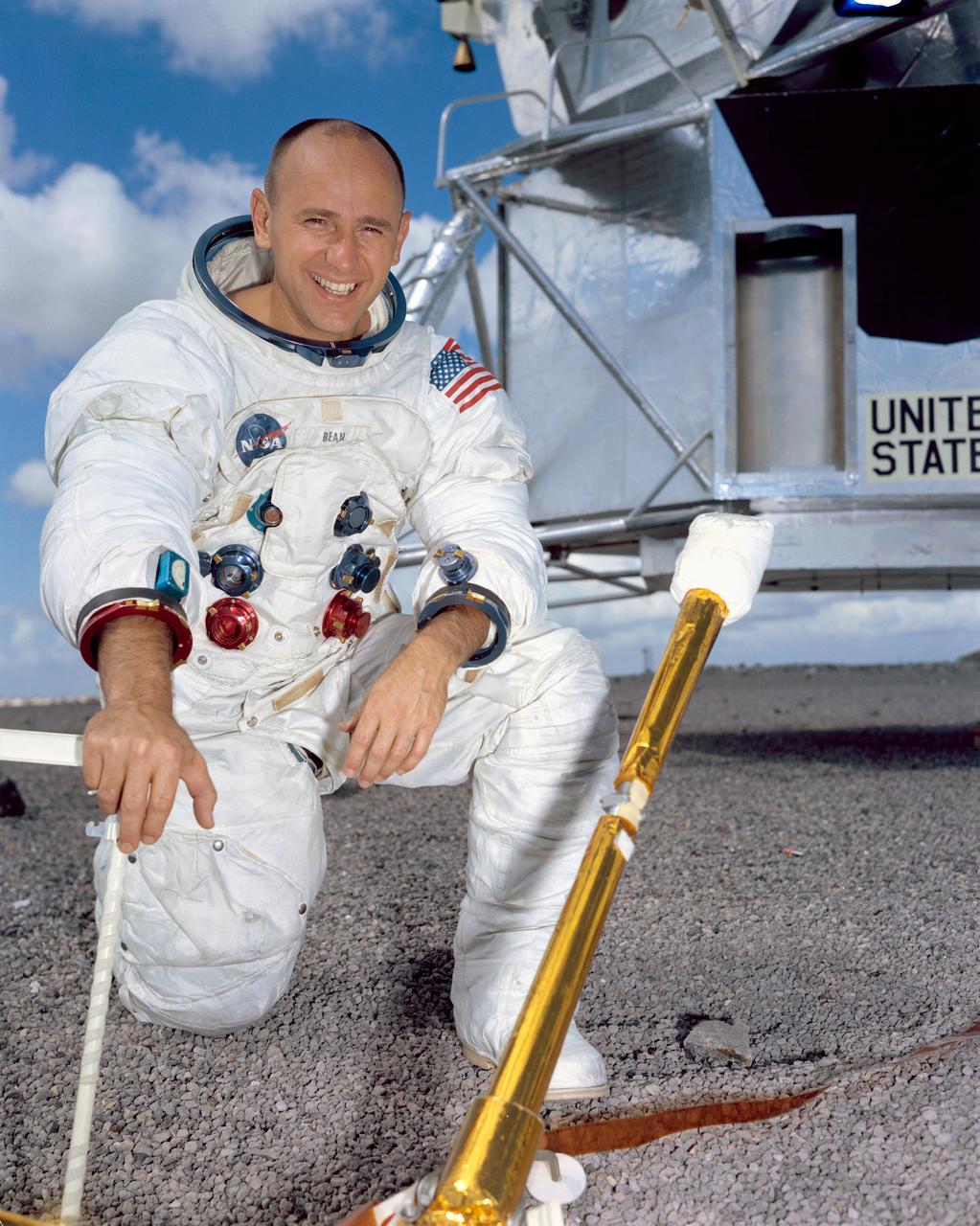

Texas roots
Bean was born in Wheeler, in the Texas Panhandle, and graduated from Paschal High School in Fort Worth. In 1949, while still a teenager, he enlisted in the Naval Reserve at Naval Air Station Dallas. As a Navy ROTC student at the University of Texas, he earned a bachelor’s degree in aeronautical engineering and was commissioned an ensign on graduation in January 1955.
Navy aviator and test pilot
Bean earned his Navy wings in 1956 and flew jet attack aircraft with Attack Squadron 44 at Naval Air Station Jacksonville, Florida. In 1960 he went to the Naval Test Pilot School at Patuxent River, Maryland, and then flew as a test pilot on several types of naval aircraft. When NASA picked him he was flying the A-4 Skyhawk with Attack Squadron 172 at Cecil Field, Florida. Over his career he logged more than 7,145 hours of flying time, 4,890 of them in jets, in 27 types of military aircraft.
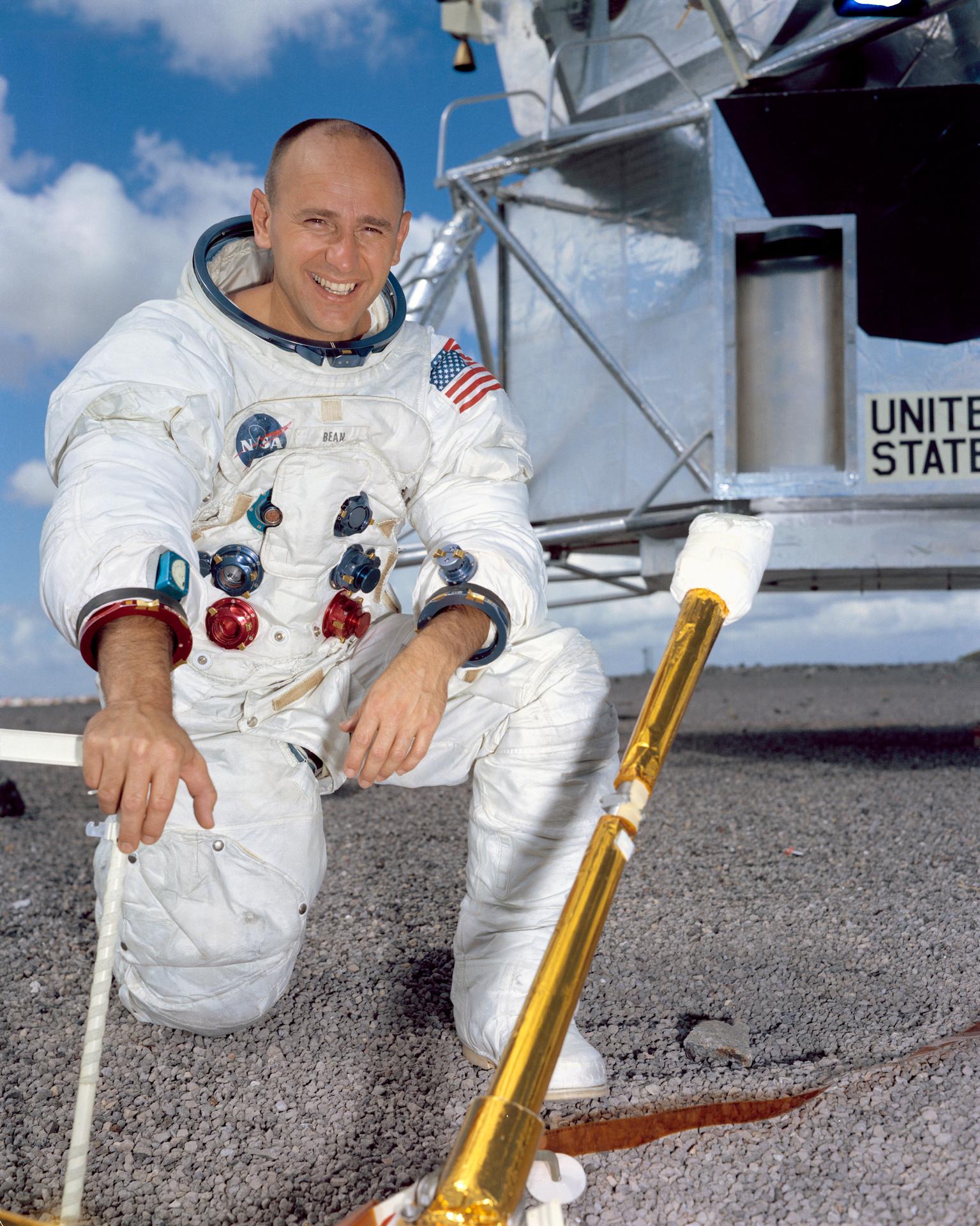
NASA, and a long wait for a flight
NASA named Bean to its third group of astronauts, 14 in all, on October 18, 1963. Several of his classmates flew in the Gemini program, but Bean’s assignments were backup roles: backup command pilot for Gemini 10 in 1966 and backup lunar module pilot for Apollo 9 in 1969, on a crew with Pete Conrad and Dick Gordon. That crew moved up to fly Apollo 12.
Apollo 12: a pinpoint landing
Apollo 12 lifted off from Kennedy Space Center at 11:22 a.m. on November 14, 1969, into rain. Lightning struck the Saturn V twice, at 36 and 52 seconds, and knocked out the spacecraft’s telemetry. The rocket kept flying, and the crew and flight controllers brought the systems back.
Apollo 11 had landed about four miles beyond its target. Apollo 12’s job was to prove that a crew could land exactly where scientists wanted. On November 19, Conrad flew the lunar module Intrepid down into the Ocean of Storms while Bean called out landmarks. They stopped about 535 feet from Surveyor 3, a robotic lander that had been there since April 1967. Gordon stayed in lunar orbit aboard the command module Yankee Clipper.
On the first moonwalk Bean set up the Apollo Lunar Surface Experiments Package, a station of instruments built to keep sending data after the crew left. Apollo 11’s smaller package had run on solar panels. Apollo 12’s ran on a SNAP-27 radioisotope generator, the first nuclear electric generator on the Moon, and NASA credits Bean with installing it. While setting up the TV camera he accidentally pointed it at the Sun, which knocked it out and ended the live television from the surface.

On the second moonwalk the two men walked down into Surveyor Crater and examined the probe. They cut away its television camera, its sampling scoop and pieces of cable and tubing to bring home, so engineers could study what 31 months on the Moon had done to them. No other crew has visited a robotic spacecraft on another world. Over the two moonwalks Conrad and Bean collected about 75 pounds (34 kilograms) of rock and soil. Apollo 12 splashed down in the Pacific on November 24.

Skylab 3: commanding a record stay
Bean flew again on July 28, 1973, as commander of Skylab 3, the second crew to live aboard America’s first space station. His crewmates were pilot Jack Lousma and science pilot Owen Garriott. All three were sick for the first days, and the first spacewalk slipped by nearly a week. Once they recovered they did about 150 percent of the work NASA had planned, from solar astronomy with the Apollo Telescope Mount to Earth observation and medical studies.

Garriott and Lousma made the mission’s first two spacewalks. Bean went outside with Garriott on September 22 for 2 hours and 41 minutes to bring in the telescope’s exposed film. When they splashed down in the Pacific southwest of San Diego on September 25, they had been in space 59 days, 11 hours and 9 minutes, more than twice the 28-day record Skylab 2 had set that June. The Skylab 4 crew passed the single-flight record on January 14, 1974, and Bean’s total-time record on January 25.

In his own words
“On Earth, I weighed 150 pounds; my suit and backpack weighed another 150. 300 pounds. Up there, I weighed only 50. So I could prance around on my toes.”
“No matter how good or bad they are, they are the first paintings in all of history of another place that an Earth human has actually seen and painted.”
Bean talked about his work at length with the publisher of this site in January 2008. Hear him in his own voice describe how he gave his paintings texture with tools he used on the Moon (question 5) and the painting he made of the crew’s homecoming (question 14), in our series Painting the Moon.
Watch
Videos play from YouTube’s privacy-enhanced player and load nothing from YouTube until you press play. See our Privacy page.
Painting the Moon
After Skylab, Bean was backup commander for the 1975 Apollo-Soyuz Test Project. He retired from the Navy as a captain in October 1975 but stayed at NASA as a civilian, heading the group that trained new astronaut candidates for the Space Shuttle. In June 1981, after 18 years as an astronaut and just after the first Shuttle flight, he resigned to paint full time.
He had taken art classes for years, and he reasoned that plenty of people could fly the Shuttle but he was the only artist who had walked on the Moon. Nearly all of his paintings are of Apollo. From 1999 he pressed a replica moon-boot sole into his panels and marked them with the geology hammer and a core-tube bit he had used on the Moon. From 2001 he worked in tiny pieces of his dust-stained spacesuit patches. In 2009 the Smithsonian’s National Air and Space Museum showed his work as “Alan Bean: Painting Apollo, First Artist on Another World” for the 40th anniversary of Apollo 11. Our Record entry on the first American astronaut to become a professional artist tells that story, and Rediscovering Alan Bean describes how his 2008 interview with this site came about.
Bean died in Houston on May 26, 2018, at 86, after a short illness. His ashes were interred at Arlington National Cemetery on November 8, 2018.
Spaceflights
| Mission | Dates | Spacecraft | Role | Days |
|---|---|---|---|---|
| Apollo 12 | Nov. 14–24, 1969 | Saturn V; CM Yankee Clipper; LM Intrepid | Lunar module pilot | 10 |
| Skylab 3 | July 28–Sept. 25, 1973 | Saturn IB; Apollo command and service module; Skylab | Commander | 59 |
Spacewalks
| Date | Partner | Duration | Main task |
|---|---|---|---|
| Nov. 19, 1969 | Pete Conrad | 3 h 56 min | On the Moon: deploy the experiments package; collect samples |
| Nov. 20, 1969 (UTC) | Pete Conrad | 3 h 49 min | On the Moon: geology traverse; visit Surveyor 3 |
| Sept. 22, 1973 | Owen Garriott | 2 h 41 min | At Skylab: retrieve and replace solar-telescope film |
| Total | 10 h 26 min | ||
Today in Space History
- September 25, 1973 Bean’s Skylab 3 crew splashes down after 59 days in space, the longest human spaceflight to that date.
- November 20, 1969 Bean and Pete Conrad visit Surveyor 3, the first time people reach a robotic spacecraft on another world.
- November 19, 1969 Apollo 12 makes the first precision landing of humans on the Moon, and Bean becomes the fourth person to walk there.
Education
- University of TexasBachelor of Science, Aeronautical Engineering, 1955
- U.S. Naval Test Pilot SchoolGraduate, 1960
- Texas Wesleyan CollegeHonorary Doctor of Science, 1972
- University of AkronHonorary Doctor of Engineering Science, 1974
Selected honors
Two NASA Distinguished Service Medals; two Navy Distinguished Service Medals; Navy Astronaut Wings; Robert J. Collier Trophy for 1973 (to the Skylab program and its astronauts); FAI Yuri Gagarin Gold Medal (1973); V. M. Komarov Diploma (1973); Dr. Robert H. Goddard Memorial Trophy (1975); AIAA Octave Chanute Award (1975); Rear Admiral William S. Parsons Award; University of Texas Distinguished Alumnus Award; National Aviation Hall of Fame (2010).
Suggested reading
Alan Bean: Painting Apollo, First Artist on Another World
The companion book to the Smithsonian’s 2009 exhibition. Bean’s paintings of Apollo appear alongside his own notes on what each scene was like and how he made it.
Apollo: An Eyewitness Account by Astronaut/Explorer Artist/Moonwalker Alan Bean
Bean’s first large collection of his paintings, with text written with Andrew Chaikin, telling the Apollo story mission by mission from the point of view of someone who was there.
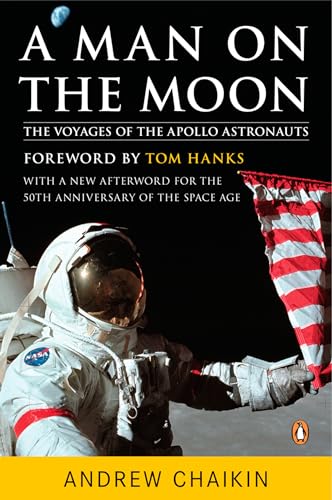
A Man on the Moon: The Voyages of the Apollo Astronauts
The standard history of the Apollo flights, built on interviews with the astronauts. Its Apollo 12 chapter follows Conrad, Gordon and Bean from the lightning strikes to Surveyor Crater.
Also worth reading: NASA’s official astronaut biography (PDF), and our Painting the Moon series with his 2008 interview recordings. Covers of Bean’s own books are not shown because they reproduce his paintings. Book links are Amazon affiliate links; Spaceflight Firsts may earn a commission on purchases.
Mission Log
Get the next astronaut bio in Mission Log.
Mission Log is the free monthly newsletter from Spaceflight Firsts: new firsts and milestones as they enter The Record, one from the past worth remembering, and the stories behind them.
One email a month. Free. We never sell or share your address. Unsubscribe anytime.
On the Record
Sources
- NASA Johnson Space Center: Alan Bean, biographical data (August 1993)
- NASA: Alan Bean (May 26, 2018)
- NASA: Former Astronaut Alan Bean
- NASA: Family Release Regarding the Passing of Apollo, Skylab Astronaut Alan Bean (May 26, 2018)
- NASA: NASA Administrator Reflects on Legacy of Record-Breaking Skylab, Apollo Astronaut (May 2018)
- NASA Image and Video Library: Alan Bean Interment, Arlington National Cemetery (November 8, 2018)
- Naval History and Heritage Command: Alan Lavern Bean (1970 officer biography)
- NASA: 60 Years Ago: NASA Selects Its Third Group of Astronauts (October 2023)
- NASA: Gemini X mission page
- NASA: Apollo 9 mission page
- NASA: Apollo 12 mission page
- NASA: Apollo 12: The Pinpoint Mission
- NASA: Lunar Encore Leads to First Precision Extraterrestrial Landing
- NASA Planetary Data System: Apollo 12 mission summary (event times in UTC)
- NASA SP-4029, Apollo by the Numbers: Extravehicular Activity
- NASA Science: Surveyor 3
- NASA/JPL Radioisotope Power Systems: Apollo Lunar Surface Experiments Package
- University of Arizona: UArizona Moon Researchers Helped NASA Nail Apollo 12 Pinpoint Landing (November 2019)
- NASA: Skylab 3 mission page
- NASA: Skylab 3: A Record 59 Days in Space
- NASA: 50 Years Ago: Skylab 2 Astronauts Splash Down After Record-Breaking 28-day Mission (June 2023)
- NASA: Skylab 4 mission page
- NASA: 50 Years Ago: Skylab 4 Astronauts Begin Record-Breaking Third Month in Space (January 2024)
- NASA: Apollo-Soyuz Test Project
- NASA: Collier Trophy winners
- National Aviation Hall of Fame: Alan L. Bean (enshrined 2010)
- Smithsonian National Air and Space Museum: Alan Bean: Painting Apollo, First Artist on Another World (exhibition, 2009–2010)
- Smithsonian Torch: “Painting Apollo, First Artist on Another World” (July 21, 2009)
- Associated Press, via the Honolulu Advertiser: interview with Alan Bean (July 20, 2009)
- Alan Bean (official site): A Message from Alan Bean
Editorial status: Current through November 22, 2026.
Sourcing note: The “first” scopes here come from NASA, which calls Apollo 12 history’s first attempt at precisely landing humans on another world; our separate Record entry for the first robotic pinpoint landing on the Moon covers Japan’s SLIM lander. Apollo 12 placed the first nuclear electric generator on the Moon, but not the first nuclear device: Apollo 11’s seismometer carried small plutonium heaters. The landing distance is NASA’s 535 feet; later orbital imaging gives 538. Spacewalk times come from NASA’s Apollo 12 mission summary and its Skylab 3 history, and they add up to the 10 hours, 26 minutes in NASA’s biography. NASA’s “pinpoint mission” page lists shorter times for each man, counted differently. The second moonwalk began at 03:54 UTC on November 20, 1969, which was the evening of November 19 in the United States. NASA pages give Surveyor 3’s landing as both April 19 and April 20, 1967; both are correct depending on time zone. NASA’s own pages also disagree on the Skylab 3 launch date (its 1993 biography says July 29 and a 2018 tribute says July 19); July 28, 1973, from NASA’s mission page, is used here. NASA’s catalog dates the Skylab spacewalk photo August 6, 1973, but its caption describes Bean’s September 22 spacewalk, the only one he made at Skylab. The time-in-space record is from NASA History, which says Bean took the record from Pete Conrad’s 49 days and lost it to the Skylab 4 crew on January 25, 1974. The Arlington burial is from NASA’s photographs of the November 8, 2018, interment.
Editorial and AI Disclosure: This article was developed with generative AI. ChatGPT prepared an initial research brief, and Claude cross-checked its factual claims against NASA and other primary sources and assisted in drafting. The publisher reviewed and approved the final article and retains responsibility for its editorial content. See our Editorial Standards & Practices.
Citation formats
- MLA McNutt, Kraig. “Alan Bean: Test Pilot, Fourth Moonwalker, Skylab Commander and Painter of the Moon.” Spaceflight Firsts, 22 Nov. 2026, www.spaceflightfirsts.com/articles/alan-bean-nasa-bio/.
- Chicago Manual of Style McNutt, Kraig. “Alan Bean: Test Pilot, Fourth Moonwalker, Skylab Commander and Painter of the Moon.” Spaceflight Firsts, November 22, 2026. https://www.spaceflightfirsts.com/articles/alan-bean-nasa-bio/.