
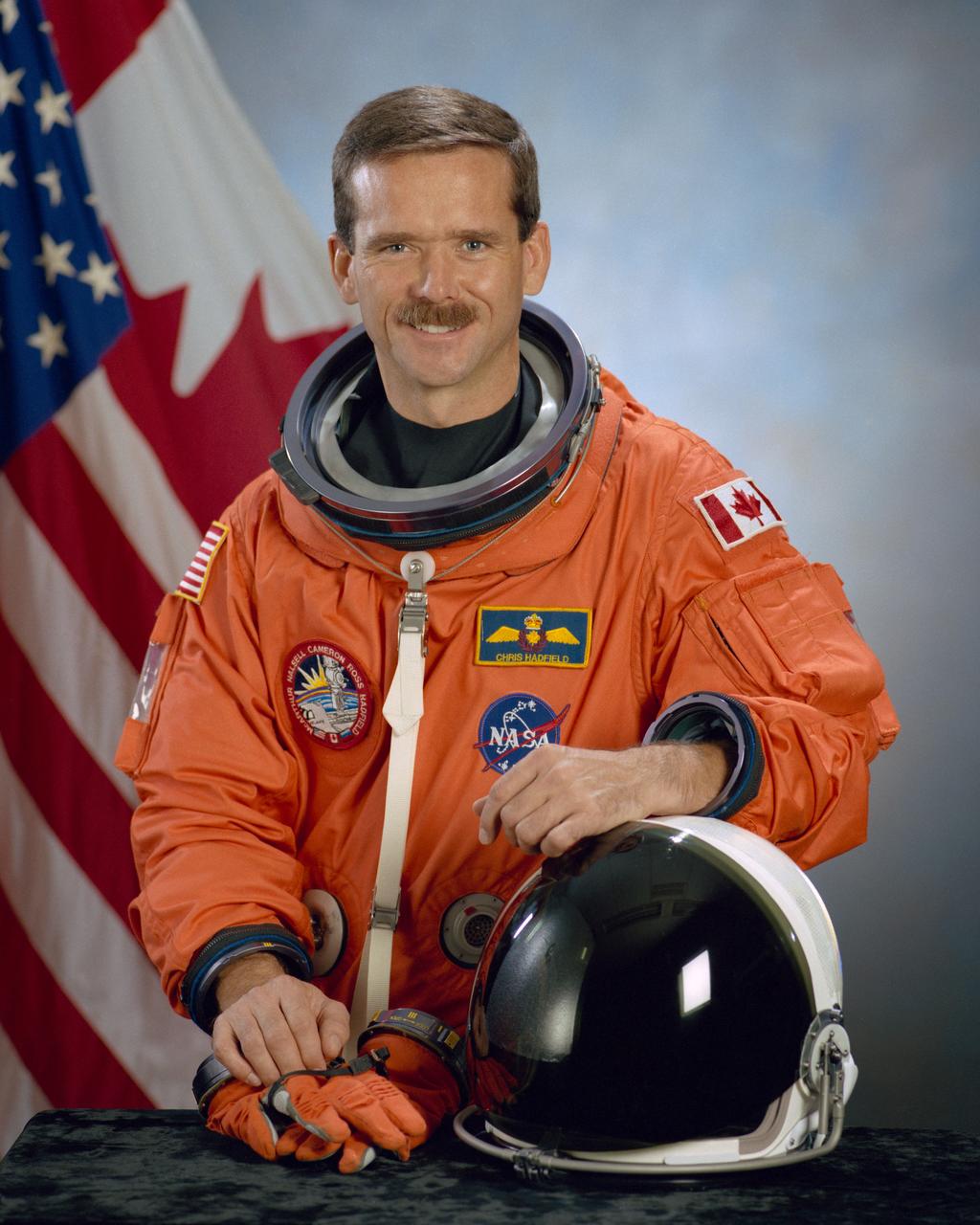

Ontario roots
Hadfield was born in Sarnia, Ontario, on August 29, 1959, grew up in Milton, west of Toronto, and graduated from Milton District High School in 1977. He wanted to be an astronaut from boyhood, but Canada had no astronaut program at the time, so he took the path that most often led there: military flying.
He joined the Canadian Armed Forces in 1978. He started at Royal Roads Military College in Victoria, British Columbia, and finished at the Royal Military College of Canada in Kingston, Ontario, with a bachelor’s degree in mechanical engineering, with honours, in 1982. That year he did postgraduate research at the University of Waterloo on aircraft fuel-pump design. It began a connection with Waterloo that brought him back as a professor three decades later.
While on exchange with the U.S. Navy, he earned a Master of Science in aviation systems, with honours, from the University of Tennessee Space Institute in Tullahoma in 1992, the year Canada chose him as an astronaut. UTSI is a graduate research campus of the University of Tennessee, Knoxville, and its degrees are UT Knoxville degrees; in Hadfield’s year they were still conferred at UT’s commencements in Knoxville. On STS-100 in 2001 he flew with Endeavour’s pilot, Jeffrey Ashby, a 1993 UTSI graduate. The university counts it as the first time two of its graduates were in space together (see our article on STS-129 and the UT Space Institute).
Fighter pilot and test pilot
Hadfield finished first in his class in basic flight training at Portage la Prairie, Manitoba, in 1980, and was the top graduate of basic jet training at Moose Jaw, Saskatchewan, in 1983. He trained on CF-5 and CF-18 fighters at Cold Lake, Alberta, then flew CF-18s for NORAD with 425 Squadron. According to the Canadian Space Agency, he flew the first CF-18 intercept of a Soviet Tu-95 “Bear” bomber.
In 1987–88 he attended the U.S. Air Force Test Pilot School at Edwards Air Force Base, California, flew 32 types of aircraft and graduated first in his class, winning the Liethen-Tittle Award. From 1989 to 1992 he served as an exchange officer with the U.S. Navy at Patuxent River, Maryland. There he tested the F/A-18 and A-7, worked on research with NASA, and flew the first flight test of the National Aerospace Plane’s external-burning hydrogen engine. The Navy named him its Test Pilot of the Year for 1991.

Astronaut, and a career between agencies
In June 1992 the Canadian Space Agency chose Hadfield as one of four new astronauts from 5,330 applicants and assigned him to NASA’s Johnson Space Center in Houston. Over the next two decades his jobs put him where the international partners met. He was CSA’s chief astronaut from 1996 to 2000 and NASA’s chief CAPCOM, the voice of Mission Control, for 25 shuttle missions. From 2001 to 2003 he was NASA’s Director of Operations at the Gagarin Cosmonaut Training Center in Star City, Russia, where he also qualified as a Soyuz flight engineer and trained in the Russian spacesuit.
Back in Houston he was chief of robotics for the astronaut office (2003–06) and chief of International Space Station operations (2006–08). He retired from the military in 2003 and stayed on as a civilian CSA astronaut. He backed up Robert Thirsk for Expedition 20/21 in 2008–09, and in 2010 he commanded NEEMO 14, an undersea test mission off Florida, before being assigned to Expedition 34/35 that September.
STS-74: the robotic arm, and Mir
Hadfield first flew on Space Shuttle Atlantis on STS-74, November 12–20, 1995, the second shuttle docking with Russia’s Mir station. Kenneth Cameron commanded, with pilot James Halsell and mission specialists William McArthur, Jerry Ross and Hadfield. The flight’s main job was delivering a Russian-built Docking Module, a tunnel that became a permanent part of Mir and gave later shuttles more clearance when docking.
On November 14, the third day of the flight, Hadfield used the Canadian-built robotic arm to lift the module out of the payload bay, swing it upright and set it onto Atlantis’s docking system, guided by the Canadian-built Advanced Space Vision System. Atlantis docked with Mir the next day. He was the first Canadian to operate Canadarm in orbit. Canadarm had first flown on STS-2 in 1981, run by NASA’s Joe Engle and Richard Truly. Hadfield is still the only Canadian ever to board Mir, and he was the first Canadian to fly as a NASA mission specialist rather than a payload specialist.
The visit brought the shuttle crew together with Mir’s crew of Yuri Gidzenko, Sergei Avdeyev and ESA’s Thomas Reiter. The Canadian Space Agency notes it was the first time astronauts from Russia, the United States, Canada and Europe were in orbit together. Atlantis also delivered a small guitar to Mir’s crew. Hadfield had heard the station’s old guitar was in bad shape and arranged for a collapsible one to fly up.

STS-100: Canadarm2 and Canada’s first spacewalks
Hadfield’s second flight was STS-100 on Space Shuttle Endeavour, April 19 to May 1, 2001, space station assembly flight 6A. Kent Rominger commanded, with pilot Jeffrey Ashby and mission specialists Scott Parazynski, John Phillips, Umberto Guidoni of ESA, Yuri Lonchakov of Russia and Hadfield. NASA called it the most internationally diverse shuttle crew to that date. Endeavour carried Canadarm2, Canada’s robotic arm for the station, and the Italian-built Raffaello logistics module.
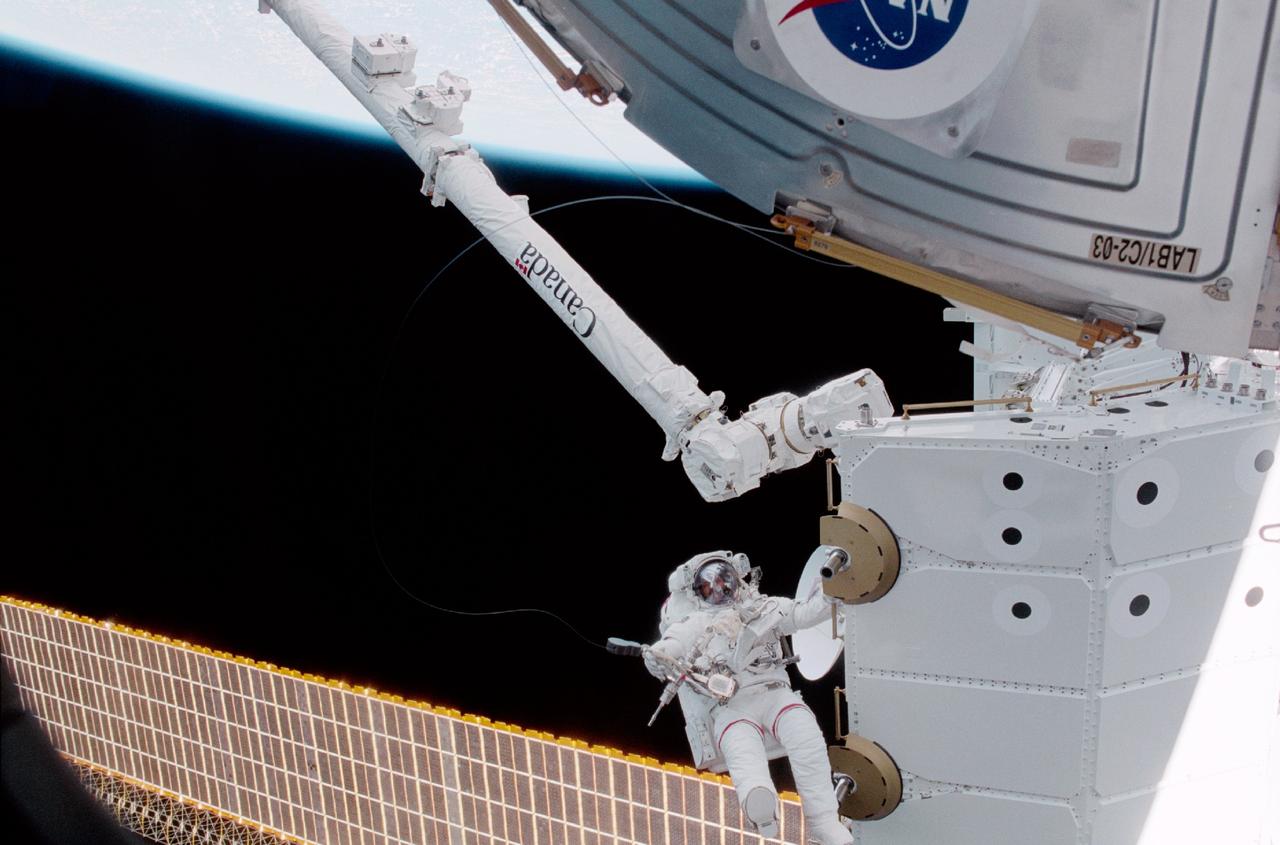
On April 22, Hadfield and Parazynski made the first of two spacewalks. They installed a UHF antenna on the Destiny laboratory, freed Canadarm2 from its launch pallet, unfolded it and connected its cables. For much of the time Hadfield rode a foot platform on the end of the shuttle’s arm, operated by Ashby. Partway through, the anti-fog solution in his helmet got into his left eye. Without gravity, his tears pooled and spread to the other eye, and for a time he could not see at all outside the station. He kept working once his eyes cleared. The 7-hour, 10-minute excursion was the first spacewalk by a Canadian. On April 24 the pair spent 7 hours and 40 minutes connecting the power and data lines Canadarm2 needed to move between grapple fixtures, removing an old antenna and stowing a spare switching unit.
On April 28 the shuttle and station crews used the two arms together. Susan Helms, at Canadarm2’s controls inside Destiny, handed the arm’s launch pallet to Endeavour’s Canadarm. Hadfield, operating the shuttle arm, grappled it and stowed it for the trip home. NASA and the Canadian Space Agency both call it the first robot-to-robot transfer in space. Canadarm2 went on to help assemble almost every piece added to the station after it.

Expeditions 34 and 35: commanding the station
Hadfield launched on his third flight on December 19, 2012, from Baikonur, Kazakhstan, aboard Soyuz TMA-07M with commander Roman Romanenko of Russia and NASA’s Tom Marshburn. Hadfield flew in the left seat as the Soyuz’s flight engineer. They docked two days later. He was the second Canadian to fly a long-duration station mission, after Robert Thirsk in 2009, and served first as a flight engineer on Expedition 34 under NASA’s Kevin Ford.
On March 13, 2013, at 5:10 p.m. Eastern time, Ford played “O Canada” over the station’s speakers and handed Hadfield command. He was the first Canadian to command the station and, as the Canadian government noted, the second commander from outside the United States and Russia, after ESA’s Frank De Winne in 2009. Expedition 35 formally began two days later, when Ford’s Soyuz undocked after a weather delay.
His two months in command were busy. The crew unloaded and packed SpaceX’s second contracted cargo Dragon, which Ford and Marshburn had captured with Canadarm2 on March 3 while Hadfield photographed its arrival. Three more crew members arrived in late March. On May 9 the crew spotted flakes of frozen ammonia streaming from the station’s port truss, a coolant leak. Two days later Marshburn and Chris Cassidy made a hastily planned spacewalk to replace a pump controller box, with Hadfield overseeing from inside. On May 12 he handed command to Pavel Vinogradov. Hadfield, Romanenko and Marshburn undocked on May 13 and landed in Kazakhstan at 02:31 UTC on May 14, the evening of May 13 in North America, after 146 days in space, 144 of them aboard the station.
Science and operations
Much of Hadfield’s career was spent on the work that lets international crews operate together: two shuttle flights with robotics, the astronaut office’s robotics branch, station operations in Houston and NASA’s operations team in Star City. On the station in 2012–13 he was the systems lead for the European and Japanese laboratory modules and worked on Canadian experiments. Among them were two cardiovascular studies led by University of Waterloo physiologist Richard Hughson on why astronauts can faint after returning to gravity, and the Radi-N2 radiation study, which used neutron bubble detectors. The Canadian Space Agency says the station crew ran more than 130 experiments during his five months aboard.
Communicating space exploration
Hadfield’s most lasting legacy may be how he talked about spaceflight. During Expeditions 34 and 35 he posted a steady stream of photographs of Earth, short videos explaining ordinary tasks in weightlessness, and conversations with the public, with help on the ground from his son Evan. Guinness World Records reports that he gathered about 770,000 Twitter followers while aboard. He held live calls with Canadian schools and universities. In a CSA project with the charity Let’s Talk Science, more than 7,000 high school students in 300 Canadian classrooms ran the same radiation experiment he was running in orbit.
Music was part of it. On February 8, 2013, CBC Music premiered “I.S.S. (Is Somebody Singing),” a song he wrote with Ed Robertson of Barenaked Ladies. Hadfield sang from the station while Robertson, the band and a Toronto high school choir performed in a CBC studio, and on May 6 he led schools across Canada in singing it from orbit for Music Monday. On May 12, the day he gave up command, he posted a reworked cover of David Bowie’s “Space Oddity,” sung and played aboard the station on the Larrivée guitar NASA had sent up in 2001, with other instruments added on Earth. Guinness World Records lists it as the first music video filmed in space.
That claim is narrow, and it should stay that way. Gemini 6 astronauts played “Jingle Bells” on a harmonica and bells in 1965, and cosmonaut Aleksandr Ivanchenko played a guitar aboard Salyut 6 in 1978. What was new with Hadfield was the size of the audience and how he reached it: a station commander using everyday social media, in real time, to make life in orbit feel familiar. When Canada appointed him an Officer of the Order of Canada, the citation honoured him “for sharing the wonders of space exploration with the world.”

After the Canadian Space Agency
Hadfield announced his retirement in June 2013, a month after landing, and left the Canadian Space Agency on July 3, 2013. That October the University of Waterloo named him a professor of aviation, and he gave his first lecture there on December 3, 2013. He has since worked as an author, speaker and broadcaster. His books include the memoir An Astronaut’s Guide to Life on Earth (2013), the photo book You Are Here (2014), the children’s book The Darkest Dark (2016), and three Cold War space thrillers: The Apollo Murders (2021), The Defector (2023) and Final Orbit (2025). He also released an album, Space Sessions: Songs from a Tin Can (2015).
He wrote the foreword to Earthrise, the account of Artemis II, which carried Canadian astronaut Jeremy Hansen around the Moon in April 2026. Hansen, then in Mission Control, had closed the May 2013 ceremony at which Hadfield handed over command of the station by thanking him on behalf of Canada.
Hadfield’s three Canadian firsts all trace back to the same deal. Canada earned its place on the shuttle by building Canadarm and its place on the station by building Canadarm2. Hadfield ran the first arm, installed the second, and then commanded the station the second arm helped build.
In his own words
“Scott, when I was a little kid wanting to grow up to be an astronaut, this is what I wanted to do.”
“With great humility and pleasure I accept command of the International Space Station.”
“This type of event is what the years of training were for.”
“With deference to the genius of David Bowie, here’s Space Oddity, recorded on Station. A last glimpse of the World.”
Watch
Videos play from YouTube’s privacy-enhanced player and load nothing from YouTube until you press play. See our privacy policy.
Spaceflights
| Mission | Dates | Spacecraft | Role | Days |
|---|---|---|---|---|
| STS-74 | Nov. 12–20, 1995 | Space Shuttle Atlantis; docked with Mir | Mission specialist | 8 |
| STS-100 | Apr. 19–May 1, 2001 | Space Shuttle Endeavour; docked with the ISS | Mission specialist; 2 spacewalks | 12 |
| Expedition 34/35 | Dec. 19, 2012–May 14, 2013 (UTC) | Soyuz TMA-07M; ISS | Soyuz flight engineer; Expedition 34 flight engineer; Expedition 35 commander | 146 |
| Total | 165 d 16 h 19 m | |||
Spacewalks
| Date | Partner | Duration | Main task |
|---|---|---|---|
| Apr. 22, 2001 | Scott Parazynski | 7 h 10 min | First Canadian spacewalk; install UHF antenna; free, unfold and connect Canadarm2 |
| Apr. 24, 2001 | Scott Parazynski | 7 h 40 min | Connect Canadarm2’s power and data lines on Destiny; remove an old antenna; stow a spare switching unit |
| Total | 14 h 50 min | NASA’s figures; the Canadian Space Agency lists 14 h 54 min (see sourcing note) | |
Today in Space History
- May 12, 2013 Hadfield hands over command of the station and posts “Space Oddity,” the first music video filmed in space.
- March 13, 2013 Hadfield becomes the first Canadian to command the International Space Station.
- April 22, 2001 Hadfield makes the first spacewalk by a Canadian, installing Canadarm2.
- November 14, 1995 Hadfield becomes the first Canadian to operate Canadarm in space.
Education
- Royal Military College of CanadaBachelor of Engineering, Mechanical Engineering (honours), 1982
- University of WaterlooPostgraduate research, Faculty of Engineering, 1982
- U.S. Air Force Test Pilot SchoolGraduate, top of class, 1988
- University of Tennessee Space InstituteMaster of Science, Aviation Systems (honours), 1992
- Royal Military College of CanadaHonorary Doctorate of Engineering, 1996
- Trent UniversityHonorary Doctor of Laws, 1999
- University of WaterlooHonorary Doctor of Science, 2014
Selected honours
Liethen-Tittle Award (1988); U.S. Navy Test Pilot of the Year (1991); Member of the Order of Ontario (1996); Vanier Award (2001); Meritorious Service Cross, military division (2001, for the first Canadian spacewalk); NASA Exceptional Service Medal (2002); Canada’s Aviation Hall of Fame (2005); Meritorious Service Cross, civil division (2013), making him the first Canadian to hold both; Officer of the Order of Canada (2014); Canada’s Walk of Fame (2018). Asteroid 14143 Hadfield is named for him.
Suggested reading

An Astronaut’s Guide to Life on Earth
Hadfield’s memoir and field guide, from his Ontario boyhood to commanding the station, with his rules for preparing for anything. Read our booknote.
You Are Here: Around the World in 92 Minutes
A selection of the photographs of Earth he took from the station, with his notes on each place.

Earthrise
The story of Artemis II and the first Canadian to travel around the Moon. Read our booknote.
Also worth reading: the Canadian Space Agency’s official biography of Chris Hadfield. Book links are Amazon affiliate links; Spaceflight Firsts may earn a commission on purchases.
Mission Log
Get the next astronaut bio in Mission Log.
Mission Log is the free monthly newsletter from Spaceflight Firsts: new firsts and milestones as they enter The Record, one from the past worth remembering, and the stories behind them.
One email a month. Free. We never sell or share your address. Unsubscribe anytime.
On the Record
Sources
- Canadian Space Agency: Biography of Chris Hadfield
- Canadian Space Agency: Mission STS-74
- Canadian Space Agency: Mission STS-100
- Canadian Space Agency: Expedition 34/35 mission objectives
- Canadian Space Agency: Expedition 34/35 mission blog
- Canadian Space Agency: Scientific experiments (Radi-N2)
- Canadian Space Agency: Chris Hadfield becomes the first Canadian Commander of the ISS (video and transcript)
- Canadian Space Agency: Music Monday downlink (video and transcript)
- NASA: STS-74 mission page
- NASA: STS-100 mission page
- NASA History: STS-100 Brings Canadian Robotic Arm to the Space Station
- NASA SP-2016-4550, Walking to Olympus: An EVA Chronology, 1997–2011
- NASA History: 40 Years Ago, STS-2
- NASA: Space Station 20th: Music on ISS
- NASA release 13-140: Expedition 35 Soyuz landing (May 2013)
- NASA: ISS Daily Summary Report, May 13, 2013
- NASA: Repairing the Station in Orbit (May 11, 2013)
- Government of Canada: Canadian astronaut Chris Hadfield first Canadian Commander of the International Space Station (March 13, 2013)
- Governor General of Canada: Meritorious Service Cross (military division) citation
- Governor General of Canada: Meritorious Service Cross (civil division)
- Governor General of Canada: Officer of the Order of Canada
- Royal Military College of Canada: Chris Austin Hadfield
- University of Tennessee Libraries, Volopedia: Chris A. Hadfield
- University of Tennessee Libraries, Volopedia: University of Tennessee Space Institute
- University of Waterloo: Canadian astronaut Chris Hadfield joins University of Waterloo (October 8, 2013)
- University of Waterloo: Chris Hadfield convocation address (honorary doctor of science, June 10, 2014)
- University of Waterloo: Hadfield space expedition to include two Waterloo kinesiology experiments (October 2012)
- Guinness World Records: First music video filmed in space
- CBC Media Centre: CBC Music premieres I.S.S. (Is Somebody Singing)
- Smithsonian Magazine: Sixty years ago, when instruments were played in space for the first time
- The Canadian Encyclopedia: Chris Hadfield
- Universe Today: Space Oddity: Hadfield Records First Music Video from Space (May 2013)
- Biography.com: Chris Hadfield
- CBC News: Chris Hadfield takes command of International Space Station (March 13, 2013)
- Spaceflight Now: Soyuz capsule brings three-man crew to safe landing (May 13, 2013)
- The Globe and Mail: “Oh man, what a view!” (April 2001)
- WBUR / Associated Press: spacewalk to fix the ammonia leak (May 11, 2013)
- Smithsonian Air & Space: The Spacewalk That Almost Killed Him
- Hachette Book Group: Final Orbit (October 7, 2025)
Editorial status: Current through November 22, 2026.
Sourcing note: Time in space is our own count from NASA’s and the Canadian Space Agency’s published launch and landing times: 8 days, 4 hours, 30 minutes (STS-74); 11 days, 21 hours, 30 minutes (STS-100); and about 145 days, 14 hours, 19 minutes (Soyuz TMA-07M). It rounds to the 166 days CSA uses. NASA’s current STS-100 mission page gives that flight’s length as 11 days, 12 hours, 54 minutes, which does not match its own launch and landing times; we use the figure from NASA History and CSA. Spacewalk times are NASA’s per-spacewalk figures, which by NASA convention run from spacesuit battery power-on to power-off. The Canadian Space Agency publishes a total of 14 hours, 54 minutes without a breakdown, and we have not found the basis for the four-minute difference. Hadfield took command on March 13, 2013; Expedition 35 formally began on March 15. He landed at 02:31 UTC on May 14, 2013 (the evening of May 13 in North America), which is why Canadian sources give May 13. The CF-18 “Bear” intercept is reported only by the Canadian Space Agency. The four-nation milestone on STS-74 is the Canadian Space Agency’s description. “Space Oddity” is a narrow first: Guinness lists it as the first music video filmed in space, not the first music in space.
Editorial and AI Disclosure: This article was developed with generative AI. ChatGPT prepared an initial research brief, and Claude cross-checked its factual claims against NASA, Canadian Space Agency and other primary sources and assisted in drafting. The publisher reviewed and approved the final article and retains responsibility for its editorial content. See our Editorial Standards & Practices.
Citation formats
- MLA McNutt, Kraig. “Chris Hadfield: Test Pilot, Spacewalker and Canada’s First Space Station Commander.” Spaceflight Firsts, 22 Nov. 2026, www.spaceflightfirsts.com/articles/chris-hadfield-csa-bio/.
- Chicago Manual of Style McNutt, Kraig. “Chris Hadfield: Test Pilot, Spacewalker and Canada’s First Space Station Commander.” Spaceflight Firsts, November 22, 2026. https://www.spaceflightfirsts.com/articles/chris-hadfield-csa-bio/.