
Tennessee roots
Wilmore grew up in Mt. Juliet, Tennessee, east of Nashville, and graduated from Mount Juliet High School. At Tennessee Technological University in Cookeville he played football and earned bachelor’s and master’s degrees in electrical engineering. Tennessee Tech later inducted him into its Sports Hall of Fame for football and gave him an honorary doctorate. He also earned a master’s in aviation systems from the University of Tennessee, studying at the UT Space Institute in Tullahoma.
“The summer between my second and third grade years of elementary school, our family relocated from the growing metropolis of Nashville to the country. We only moved twenty miles from where we were living, but it felt like a completely different world.”
Carrier aviator and test pilot
Wilmore became a Navy aviator and flew the A-7E Corsair II and the F/A-18 Hornet from the carriers USS Forrestal, USS John F. Kennedy, USS Enterprise and USS Dwight D. Eisenhower. He flew 21 combat missions in Operation Desert Storm from the Kennedy, and later missions over Iraq and Bosnia. By the time he joined NASA he had logged more than 8,000 flight hours and 663 carrier landings, all in tactical jets.
After graduating from the U.S. Naval Test Pilot School, he worked on the initial development of the T-45 Goshawk jet trainer, including its first carrier landing certification and high angle-of-attack testing. He taught at the Navy’s test pilot school and then, on exchange, at the Air Force Test Pilot School at Edwards Air Force Base, California.

NASA, and a first flight on Atlantis
NASA selected Wilmore as an astronaut in July 2000. His early technical jobs included representing the astronaut office on the shuttle’s propulsion systems, its main engines, solid rocket motors and external tank, and leading the astronaut support team at Kennedy Space Center for launches and landings.
He first flew as pilot of Space Shuttle Atlantis on STS-129, November 16–27, 2009. The crew, commanded by Charlie Hobaugh and including future Artemis III commander Randy Bresnik, delivered spare parts to the space station and brought home Nicole Stott after her long-duration stay.
“I launched from Kennedy Space Center (KSC), Florida, as Pilot (PLT) of the STS-129 mission in 2009 aboard Space Shuttle Atlantis and on the Russian Soyuz from Baikonur, Kazakhstan, in 2014. Both missions had taken me to the ISS, the first on an eleven-day mission and the second for six months.”
Commanding the station, and printing in space
Wilmore launched on Soyuz TMA-14M with cosmonauts Alexander Samokutyaev and Elena Serova on September 25, 2014. He served as a flight engineer on Expedition 41 and took command of the station in November 2014 for Expedition 42. On October 15, 2014, he made his first spacewalk, with Reid Wiseman, to replace a failed voltage regulator.
That November, he installed an experimental 3D printer built by Made In Space and ran its first calibration print. On November 24, controllers on the ground commanded it to print a faceplate for its own extruder, engraved with the names of NASA and Made In Space. It was the first part made in space by 3D printing. Wilmore removed it and inspected it the next morning.
A few weeks later, Made In Space engineers heard Wilmore mention over the radio that he needed a ratcheting socket wrench. They designed one, NASA sent the file to the station, and the printer built it in about four hours. It was the first time a tool had been designed on Earth and transmitted to space to be manufactured.

In February and March 2015, Wilmore and Terry Virts made three spacewalks to run cables and prepare the station for the International Docking Adapters that commercial crew spacecraft would use. Wilmore landed in Kazakhstan on March 12, 2015 (March 11 in the U.S.) after 167 days in space and four spacewalks totaling 25 hours, 36 minutes.

Starliner’s first crew
On June 5, 2024, Wilmore and Suni Williams lifted off from Cape Canaveral on a United Launch Alliance Atlas V aboard Boeing’s Starliner on NASA’s Boeing Crew Flight Test, the spacecraft’s first flight with people aboard. Wilmore was commander. Helium leaks and thruster failures during the approach made the June 6 docking harder than planned. NASA decided to bring the capsule home without its crew, and Starliner landed uncrewed at White Sands, New Mexico, on September 7, 2024.
Wilmore and Williams joined the station crew on Expeditions 71 and 72. On January 30, 2025, Wilmore made his fifth spacewalk, with Williams, to remove a faulty radio antenna assembly and swab the station’s exterior for microbes. They came home with Nick Hague and Aleksandr Gorbunov on NASA’s SpaceX Crew-9 mission, aboard the Crew Dragon Freedom, splashing down off Tallahassee, Florida, on March 18, 2025, after 286 days in space. In February 2026, NASA classified the Starliner flight a Type A mishap, its most serious category. For more, read What “Stuck” Meant: The Starliner Crew’s 286 Days in Context.

In his own words
“We don’t feel abandoned, we don’t feel stuck, we don’t feel stranded.”
“We’re going to rectify all the issues that we encountered. We’re going to fix them. We’re going to make it work.”
At the same news conference, Wilmore said he would fly Starliner again “in a heartbeat,” and he accepted a share of the responsibility for the flight’s problems, saying he could have asked questions before launch that might have made a difference.
Watch
Videos play from YouTube’s privacy-enhanced player and load nothing from YouTube until you press play. See our Privacy page.
Retirement
NASA announced Wilmore’s retirement on August 6, 2025, after 25 years with the agency. In March 2026 he published a memoir, Stuck in Space, which tells the story of the Starliner flight alongside the Christian faith he says sustained him.
Spaceflights
| Mission | Dates | Spacecraft | Role | Days |
|---|---|---|---|---|
| STS-129 | Nov. 16–27, 2009 | Space Shuttle Atlantis | Pilot | 11 |
| Expedition 41/42 | Sept. 25, 2014–Mar. 12, 2015 | Soyuz TMA-14M | Flight engineer (Exp. 41); commander (Exp. 42) | 167 |
| Boeing Crew Flight Test; Expedition 71/72; return on Crew-9 | June 5, 2024–Mar. 18, 2025 | Starliner Calypso (up); Crew Dragon Freedom (down) | Commander (CFT); flight engineer | 286 |
Spacewalks
| Date | Partner | Duration | Main task |
|---|---|---|---|
| Oct. 15, 2014 | Reid Wiseman | 6 h 34 min | Replace a failed voltage regulator |
| Feb. 21, 2015 | Terry Virts | 6 h 41 min | Cabling for commercial crew docking adapters |
| Feb. 25, 2015 | Terry Virts | 6 h 43 min | Cabling for commercial crew docking adapters |
| Mar. 1, 2015 | Terry Virts | 5 h 38 min | Cabling and antenna work for commercial crew vehicles |
| Jan. 30, 2025 | Suni Williams | 5 h 26 min | Remove a radio antenna assembly; collect microbe samples |
| Total | 31 h 2 min | ||
Today in Space History
- March 18, 2025 Wilmore and Suni Williams splash down off Florida on NASA’s SpaceX Crew-9 mission, ending 286 days in space.
- June 5, 2024 Wilmore commands the first crewed launch of Boeing’s Starliner, the first crew on any Atlas rocket since Gordon Cooper’s Mercury-Atlas 9 in 1963.
- November 24, 2014 The 3D printer Wilmore installed aboard the station makes the first part ever manufactured in space.
Education
- Tennessee Technological UniversityBachelor of Science, Electrical Engineering, 1985
- U.S. Naval Test Pilot SchoolGraduate, 1992
- Tennessee Technological UniversityMaster of Science, Electrical Engineering, 1994
- University of Tennessee (UT Space Institute, UTSI)Master of Science, Aviation Systems, 1994
- Tennessee Technological UniversityHonorary doctorate, 2012
Selected honors
Legion of Merit; Defense Superior Service Medal; NASA Distinguished Service Medal; NASA Space Flight Medals; five Air Medals, three with Combat “V”; six Navy Commendation Medals, three with Combat “V”; NCAA Theodore Roosevelt Award (2018); University of Tennessee Top 100 Centennial Alumni (2017); U.S. Atlantic Fleet Strike Fighter Aviator of the Year (1999).
Suggested reading
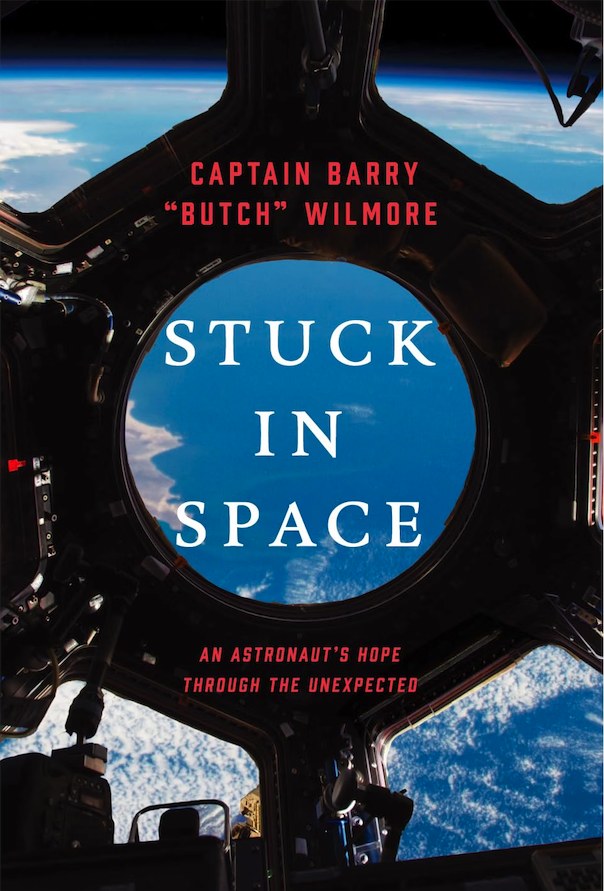
Stuck in Space: An Astronaut’s Hope Through the Unexpected
Wilmore’s own account. Each chapter opens with a stage of the Starliner flight, from launch preparations to the thruster failures, and the book is also a testimony of his Christian faith.

Who Are Suni and Butch?
A short illustrated biography of Wilmore and Williams for young readers, covering their careers and the Starliner flight that became a nine-month stay.
Also worth reading: The Space Review’s review of Stuck in Space, and NASA’s official astronaut biography (PDF). Book links are Amazon affiliate links; Spaceflight Firsts may earn a commission on purchases.
Mission Log
Get the next astronaut bio in Mission Log.
Mission Log is the free monthly newsletter from Spaceflight Firsts: new firsts and milestones as they enter The Record, one from the past worth remembering, and the stories behind them.
One email a month. Free. We never sell or share your address. Unsubscribe anytime.
On the Record
Sources
- NASA Johnson Space Center: Barry E. “Butch” Wilmore, astronaut biography (August 2023)
- NASA: Astronaut Barry “Butch” Wilmore Retires (August 6, 2025)
- NASA: STS-129 mission page
- NASA: Expedition 41 mission page
- NASA: Expedition 42 mission page
- NASA: Boeing Crew Flight Test mission page
- NASA: Expedition 71 mission page
- NASA: Expedition 72 mission page
- NASA: SpaceX Crew-9 mission page
- NASA: Expedition 41 Crew Launches to the International Space Station (Soyuz TMA-14M, September 2014)
- NASA: The Space Shuttle (Orbiter Atlantis, OV-104)
- NASA: Mercury-Atlas 9: Faith 7
- NASA: Open for Business: 3-D Printer Creates First Object in Space (November 2014)
- NASA: Space Station 3-D Printer Builds Ratchet Wrench (December 22, 2014)
- Core77, quoting Made In Space founder Mike Chen (December 2014)
- NASA: Liftoff! NASA’s Boeing Crew Flight Test Heads to Space Station (June 5, 2024)
- NASA: Spacewalkers Complete Radio Hardware Removal and Microbe Search (January 30, 2025)
- NASA: Welcome Home: NASA’s SpaceX Crew-9 Back on Earth (March 18, 2025)
- NASA: NASA Releases Report on Starliner Crewed Flight Test Investigation (February 2026)
- NASA: Station Record Holders
- TASS: Factbox: Mankind sends 631 people into space in recorded history
- CNN (via AccuWeather): Weeks from homecoming, Boeing Starliner astronauts want to set the record straight (February 14, 2025)
- Associated Press (via Scripps News): NASA’s newly returned astronauts say they would fly on Boeing’s Starliner capsule again (March 31, 2025)
- University of Tennessee Libraries, Volopedia: Barry E. “Butch” Wilmore
- Tennessee Tech Visions: Barry Wilmore, ’85, ’94 electrical engineering
- University of Tennessee: Centennial Alumni, Barry Wilmore (2017)
- UT Alumni: Barry E. “Butch” Wilmore (’94), 2025 Distinguished Alumni Award
- Wikipedia: Barry E. Wilmore (birth date and place)
- The Space Review: Review: Stuck in Space
- Today’s Christian Entertainment: Wilmore memoir announcement (February 11, 2026)
Editorial status: Current through November 22, 2026.
Sourcing note: NASA’s retirement release gives Wilmore’s spacewalk time as “32 hours.” The 31 hours, 2 minutes used here is the sum of NASA’s published durations for his five spacewalks. NASA calls the November 24, 2014, faceplate the first object printed in space; calibration test prints were made on November 17 and 20. The wrench detail (“heard Wilmore mention over the radio”) comes from Made In Space, not NASA. The time-in-space ranking is the publisher’s count: NASA’s cumulative table (updated January 15, 2026) lists seven astronauts above 464 days (Whitson, S. Williams, Pettit, Fincke, J. Williams, Vande Hei, Kelly), and the 369 total is TASS’s count of Americans who have flown in space. NASA does not publish a full ranking. Degree years come from Tennessee Tech (bachelor’s 1985 and master’s 1994, both electrical engineering, per its Visions magazine) and the University of Tennessee (UTSI master’s 1994; Naval Test Pilot School 1992). Some Tennessee Tech athletics pages call the 1985 degree mechanical engineering; NASA’s biography and Tennessee Tech’s magazine say electrical engineering, which is used here.
Editorial and AI Disclosure: This article was developed with generative AI. ChatGPT prepared an initial research brief, and Claude cross-checked its factual claims against NASA and other primary sources and assisted in drafting. The publisher reviewed and approved the final article and retains responsibility for its editorial content. See our Editorial Standards & Practices.
Citation formats
- MLA McNutt, Kraig. “Butch Wilmore: Navy Test Pilot, Station Commander and Starliner’s First Crew.” Spaceflight Firsts, 22 Nov. 2026, www.spaceflightfirsts.com/articles/butch-wilmore-nasa-bio/.
- Chicago Manual of Style McNutt, Kraig. “Butch Wilmore: Navy Test Pilot, Station Commander and Starliner’s First Crew.” Spaceflight Firsts, November 22, 2026. https://www.spaceflightfirsts.com/articles/butch-wilmore-nasa-bio/.