
Elmira
Eileen Marie Collins was born on November 19, 1956, in Elmira, New York, to James and Rose Marie Collins. A 1969 family photograph shows her with her brothers and sisters at Harris Hill, Elmira’s glider field and the home of the National Soaring Museum. She has said she began reading about the Mercury astronauts as a child, at a time when, in her words, “there were no women astronauts.”
Her family did not have money for college. After graduating from Elmira Free Academy in 1974, she worked full time to put herself through Corning Community College, where she earned an associate degree in mathematics and science in 1976, and to pay for flying lessons. An Air Force ROTC scholarship took her to Syracuse University. “I picked Syracuse because the ROTC people were wonderful,” she said in 2021. She graduated in 1978 with a bachelor’s degree in mathematics and economics and a commission in the Air Force.
Air Force pilot, instructor and test pilot
Collins entered the Air Force as its pilot training opened to women. The first ten women had graduated from its undergraduate pilot training in 1977. Collins earned her wings at Vance Air Force Base, Oklahoma, in 1979, in the first class there to include women, according to the National Aviation Hall of Fame. Vance kept her as a T-38 Talon instructor pilot until 1982.
From 1983 to 1985 she was a C-141 Starlifter aircraft commander and instructor pilot at Travis Air Force Base, California. She served in Operation Urgent Fury, the October 1983 U.S. operation in Grenada, and received the Armed Forces Expeditionary Medal. A year as an Air Force Institute of Technology student produced a master’s degree in operations research from Stanford University in 1986. From 1986 to 1989 she taught mathematics at the U.S. Air Force Academy as an assistant professor and instructed cadets in the T-41, and in 1989 she added a master’s degree in space systems management from Webster University.
She was then accepted to the Air Force Test Pilot School at Edwards Air Force Base, California, the second woman pilot to attend it, according to Syracuse University. She was still a student there when NASA chose her, and she graduated in 1990. By the time she retired from the Air Force in January 2005, as a colonel, she had logged more than 6,751 hours in 30 types of aircraft.
NASA’s first woman pilot candidate

Women had flown on the shuttle since Sally Ride’s STS-7 in 1983, but all of them as mission specialists or payload specialists, the crew members who run experiments, robotic arms and spacewalks. Pilots and commanders, who fly the orbiter, came from the test-pilot ranks, and no woman had been selected for that track. On January 17, 1990, NASA announced its 13th astronaut group: 23 candidates, seven of them pilots. Collins was the first woman among NASA’s pilot astronauts.
The group reported to the Johnson Space Center on July 16, 1990, and Collins qualified as an astronaut in July 1991. Her ground jobs over the next 15 years included orbiter engineering support, work on the team that prepared orbiters and crews at Kennedy Space Center for launch and landing, and duty as a capsule communicator in Mission Control. She later served as chief of the Astronaut Office’s spacecraft systems, shuttle and safety branches and as its chief information officer.
STS-63: The first woman in the pilot’s seat
Collins first flew as pilot of Discovery on STS-63, which lifted off from Kennedy Space Center at 12:22 a.m. EST on February 3, 1995. Her commander was James Wetherbee. The crew included Michael Foale, Janice Voss, Bernard Harris and the Russian cosmonaut Vladimir Titov. NASA photographs show seven women from the 1960s private “Woman in Space” testing program, often called the Mercury 13, at Kennedy for the launch.
The flight’s main job was a rehearsal. It was the first in NASA’s series of shuttle flights to Russia’s Mir station, and it was the shuttle’s first launch into the 51.6-degree orbit Mir flew in, with a launch window of about five minutes. Soon after reaching orbit, two of the orbiter’s small steering thrusters began to leak, one of them a jet needed for the approach. A third leaked later in the flight. Engineers in Houston and Moscow debated whether Discovery could safely approach the station. The crew closed off the leaking thruster and switched to a backup.

On February 6 Russian managers gave the go. With Wetherbee flying manually, Discovery closed to 37 feet from Mir, backed off to about 400 feet and flew one and a quarter loops around the station while it was filmed and photographed. It was the first time a shuttle had approached and circled a Russian station. The docking itself came later, on STS-71 in June 1995. STS-63 also flew the Spacehab-3 laboratory and released and recovered the Spartan-204 astronomy satellite. On February 9 Harris and Foale made a spacewalk, and Harris became the first African American to walk in space. Discovery landed at Kennedy on February 11 after 8 days, 6 hours and 28 minutes.
STS-84: Shuttle-Mir
Collins flew as pilot again on STS-84, aboard Atlantis, which launched at 4:07 a.m. EDT on May 15, 1997. Her commander was Charles Precourt, a classmate from Group 13. The crew included Edward Lu, Carlos Noriega, Jean-François Clervoy of the European Space Agency and Elena Kondakova of Russia.
Atlantis docked with Mir at 10:33 p.m. EDT on May 16, the sixth shuttle docking with the station. The flight swapped one American resident of Mir for another: Michael Foale moved in, and Jerry Linenger, who had lived aboard for 123 days, including through a fire in February, came home. The crew moved nearly four tons of supplies and equipment between the two spacecraft before undocking. Atlantis landed at Kennedy on May 24 after 9 days, 5 hours and 20 minutes.

Both Mir flights gave Collins experience in the rendezvous and docking work that NASA would rely on to build the International Space Station.
STS-93: Command
In late February 1998 the deputy director of the Johnson Space Center, James Wetherbee, her STS-63 commander, told Collins she would command STS-93. NASA had judged the assignment important enough to notify the White House. On March 5, 1998, First Lady Hillary Rodham Clinton announced it in the Roosevelt Room, with President Bill Clinton and NASA Administrator Dan Goldin. Clinton recalled that NASA had told her, when she wrote as a 14-year-old in 1962, that women were not being considered for spaceflight.
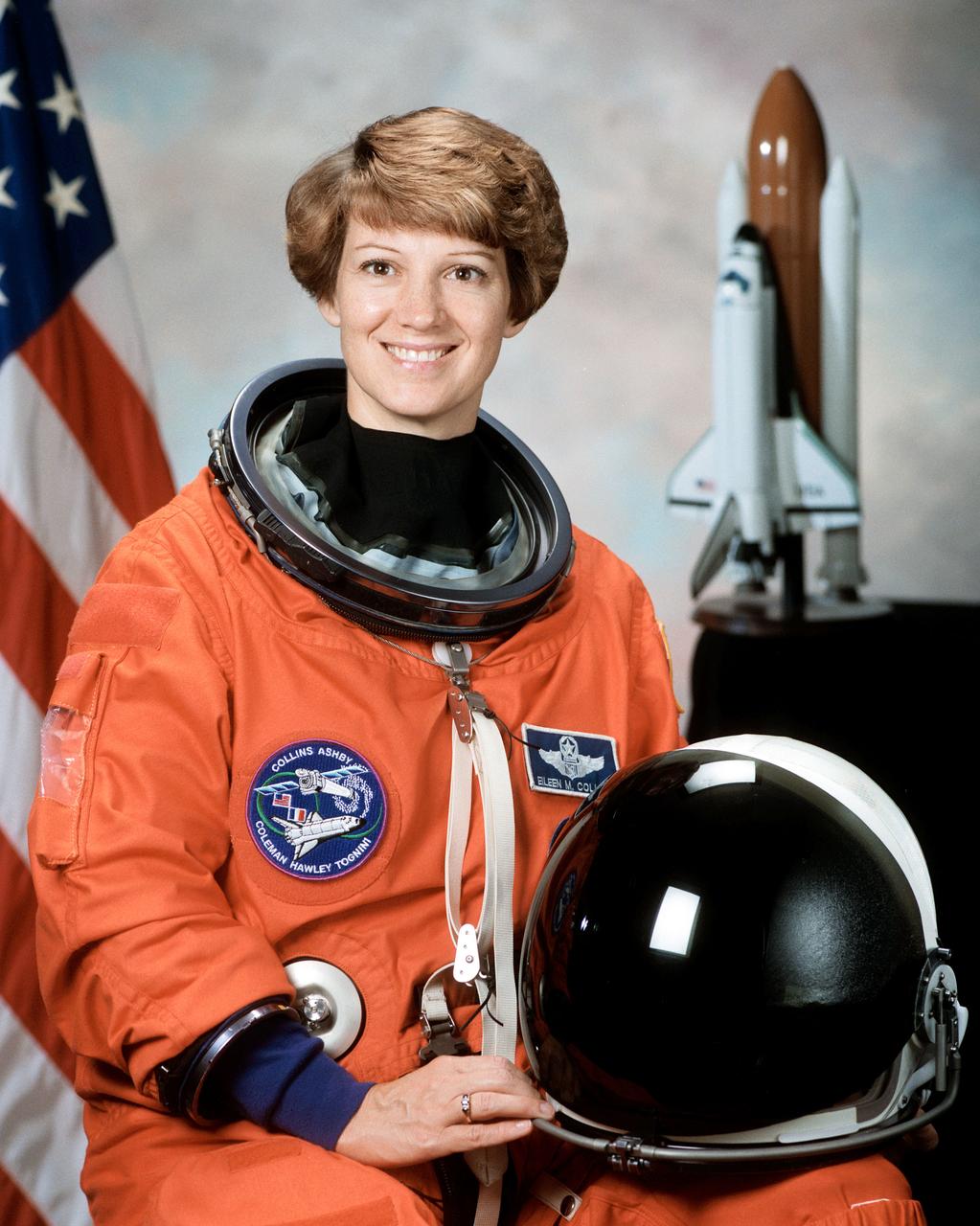
Collins’s crew was Jeffrey Ashby, a first-time pilot, and mission specialists Steven Hawley, Catherine “Cady” Coleman and Michel Tognini of the French space agency, CNES. Their main job was to deploy the Chandra X-ray Observatory. With the Inertial Upper Stage booster that would carry it to its high orbit, Chandra weighed 50,162 pounds and ran 57 feet long, nearly the whole payload bay. NASA still lists it as the heaviest payload the shuttle ever launched. NASA dedicated the launch to women aviators, and Collins invited members of the Women Airforce Service Pilots of World War II and the women of the Lovelace testing program. She had thanked both groups in her White House remarks.
The countdown took three tries. On July 20 the launch team stopped the clock about seven seconds before liftoff after a sensor showed hydrogen in the engine compartment, a reading later judged false. Weather scrubbed the next attempt. Columbia lifted off at 12:31 a.m. EDT on July 23, 1999.
The ascent was harder than it looked from the ground. About five seconds after liftoff an electrical short dropped the voltage on one of the orbiter’s power buses. It took out one of the two redundant controllers on each of two main engines. Both engines kept running on their remaining controllers, but another failure in either one could have forced a dangerous abort. At the same time, a pin had come loose inside the right engine at ignition and punched holes in three of the hydrogen cooling tubes in its nozzle. The leak made the engines burn extra oxidizer, and they shut down slightly early, leaving Columbia in an orbit about seven miles lower than planned. The orbiter’s own engines made up the difference.

A little more than seven hours after launch, Coleman released Chandra and its booster, and Collins and Ashby flew Columbia to a safe distance before the booster fired. Chandra reached its working orbit, which takes it more than a third of the way to the Moon, after about ten days of its own engine burns. Built for a five-year mission, it was still observing in 2026, on a reduced budget. The crew spent the rest of the flight on about 20 smaller experiments and landed at Kennedy at 11:20 p.m. EDT on July 27, after 4 days, 22 hours and 50 minutes. It was the shuttle’s 12th night landing.

Investigators traced the short to a wire with worn insulation that had rubbed against a burred screw head, probably for years. The finding led NASA to change how it inspected and protected orbiter wiring. Columbia did not fly again until March 2002.
STS-114: Leading the return to flight
In August 2001 NASA named Collins commander of STS-114, then a routine flight to rotate space station crews, with pilot James Kelly and mission specialists Stephen Robinson and Soichi Noguchi of Japan. On February 1, 2003, Columbia broke apart during reentry, and the seven astronauts aboard were killed. A piece of foam from the external tank had broken a hole in the left wing’s leading edge during launch. The remaining shuttles were grounded, and STS-114 became the first flight back.
NASA rebuilt the mission as a test flight. In November 2003 it added three mission specialists: Andrew Thomas, Wendy Lawrence and Charles Camarda. The crew’s job was to show that the shuttle could be launched with less foam shedding, inspected in orbit, and repaired there if needed. For two and a half years, while engineers redesigned the tank and built new cameras, sensors and an inspection boom, Collins’s crew trained on the new procedures and visited the factories and workers who built the shuttle’s parts.
After a scrub on July 13 caused by a faulty fuel sensor, Discovery launched at 10:39 a.m. EDT on July 26, 2005. The new cameras showed that a large piece of foam had come off the external tank. NASA announced the next day that the shuttle fleet would not fly again until the problem was solved. On the second day in orbit the crew used the new Orbiter Boom Sensor System to scan the wing leading edges and nose cap with lasers.
The rendezvous with the space station on July 28 brought the flight’s most visible first. With Kelly beside her, Collins stopped Discovery about 600 feet below the station and flew it through a slow, full backflip at three-quarters of a degree per second. As the orbiter’s belly turned toward the station, Sergei Krikalev and John Phillips of the Expedition 11 crew photographed its heat-shield tiles with 400-millimeter and 800-millimeter lenses. They had about 90 seconds for the key images. Engineers on the ground examined the photos for damage. Discovery docked at 7:18 a.m. EDT.

NASA engineers had designed the rendezvous pitch maneuver after the Columbia accident, and it had never been flown. Every later shuttle flight to the station repeated it, through the final mission in 2011. Collins said in 2021 that her crew was allowed to help develop it. The maneuver was the crew’s and Mission Control’s work as much as hers. As commander, she flew it.
The photos and the boom’s scans found two thin strips of fabric, called gap fillers, sticking out between tiles on Discovery’s belly. After several days of analysis, managers decided to remove them. On August 3, on the third of his spacewalks with Noguchi, Robinson rode the station’s robotic arm under the orbiter and pulled them out by hand. NASA called it a first-of-its-kind spacewalking repair. The earlier spacewalks had tested repair materials on damaged tile samples and replaced one of the station’s four gyroscopes. The crew also delivered and returned the Raffaello cargo module, and the mission was extended by a day.
Weather waved off four landing chances at Kennedy on August 8 and 9. Collins brought Discovery down in darkness at Edwards Air Force Base, California, at 5:11 a.m. PDT on August 9, after 13 days, 21 hours and 33 minutes and 5.8 million miles. The next shuttle flight, STS-121, did not launch until July 2006.
Retirement and later years
Collins retired from NASA in May 2006, with four flights and about 872 hours in space. She did not fly again, but she continued to speak and serve. In 2016 she spoke at the Republican National Convention in Cleveland, calling for the United States to lead in space again. In 2018 she was named to the National Space Council’s Users’ Advisory Group, which first met that June.
In October 2021 Arcade published her memoir, Through the Glass Ceiling to the Stars, written with the space historian Jonathan H. Ward. The book became the basis of Spacewoman, a feature documentary directed by Hannah Berryman, which opened in U.S. theaters on March 20, 2026. Collins has appeared at screenings and talks across the country since then.
As NASA’s historian noted in 2024, her selection helped open the commander’s seat to other women. Pamela Melroy commanded STS-120 in 2007, as the second and last woman to command a shuttle. Women have since commanded the space station and other crewed missions.
In her own words
“It’s the greatest adventure on this planet-or off the planet, for that matter. I wanted to fly the Space Shuttle.”
“Hopefully not for long!”
“As the first woman shuttle pilot, I wanted to set a good impression that would lead to future opportunities for women.”
“NASA was willing to let us develop the RPM, and our crew was the first to do it. Every shuttle mission after ours that went to the space station did that maneuver.”
Watch
Videos play from YouTube’s privacy-enhanced player and load nothing from YouTube until you press play. See our Privacy page.
Spaceflights
| Mission | Dates | Spacecraft | Role | Duration | Highlights |
|---|---|---|---|---|---|
| STS-63 | Feb. 3–11, 1995 | Discovery | Pilot | 8 d 6 h 28 min | First woman shuttle pilot; first shuttle approach to and flyaround of Mir |
| STS-84 | May 15–24, 1997 | Atlantis | Pilot | 9 d 5 h 20 min | Sixth Shuttle-Mir docking; Foale replaced Linenger aboard Mir |
| STS-93 | July 23–27, 1999 | Columbia | Commander | 4 d 22 h 50 min | First woman shuttle commander; deployed Chandra, the heaviest shuttle payload |
| STS-114 | July 26–Aug. 9, 2005 | Discovery | Commander | 13 d 21 h 33 min | Return to flight after Columbia; first rendezvous pitch maneuver; heat-shield repair on a spacewalk |
| Total | 36 d 8 h 11 min | About 872 hours | |||
Today in Space History
- July 28, 2005 Collins flies Discovery through the first rendezvous pitch maneuver below the International Space Station.
- July 23, 1999 Columbia launches on STS-93, the first shuttle mission commanded by a woman.
- February 3, 1995 Discovery launches on STS-63 with Collins as the first woman shuttle pilot.
Education
- Elmira Free AcademyHigh school diploma, 1974
- Corning Community CollegeAssociate in Science, Mathematics/Science, 1976
- Syracuse UniversityBachelor of Arts, Mathematics and Economics, 1978
- Stanford UniversityMaster of Science, Operations Research, 1986 (as an Air Force Institute of Technology student)
- Webster UniversityMaster of Arts, Space Systems Management, 1989
- U.S. Air Force Test Pilot SchoolGraduate, 1990
- Syracuse UniversityHonorary doctorate, 2001 (Commencement speaker)
Selected honors
Defense Superior Service Medal; Distinguished Flying Cross; Defense Meritorious Service Medal; Air Force Meritorious Service Medal and Air Force Commendation Medal, each with one oak leaf cluster; Armed Forces Expeditionary Medal (Grenada, 1983); French Legion of Honor; NASA Outstanding Leadership Medal; NASA Space Flight Medals; Free Spirit Award; National Space Trophy. Inducted into the National Women’s Hall of Fame (1995), the National Aviation Hall of Fame (2009), the U.S. Astronaut Hall of Fame (2013) and the Texas Aviation Hall of Fame (2020). National Aeronautic Association Wright Brothers Memorial Trophy (2022). Syracuse University’s George Arents Pioneer Medal (1996) and Military/Veteran Award (2021). Corning Community College’s observatory is named for her.
Suggested reading

Through the Glass Ceiling to the Stars: The Story of the First American Woman to Command a Space Mission
Collins’s own account, from Elmira and Air Force pilot training through her four flights and the return to flight after Columbia. It is the source of the documentary Spacewoman.

Bringing Columbia Home: The Untold Story of a Lost Space Shuttle and Her Crew
Kennedy Space Center’s last shuttle launch director tells the story of the search for Columbia and the recovery that led to the return to flight Collins commanded.
Also worth reading: NASA’s official astronaut biography (PDF, May 2006). Book links are Amazon affiliate links; Spaceflight Firsts may earn a commission on purchases.
Mission Log
Get the next astronaut bio in Mission Log.
Mission Log is the free monthly newsletter from Spaceflight Firsts: new firsts and milestones as they enter The Record, one from the past worth remembering, and the stories behind them.
One email a month. Free. We never sell or share your address. Unsubscribe anytime.
On the Record
Sources
- NASA Johnson Space Center: Eileen Marie Collins biographical data (PDF, May 2006)
- NASA: Former Astronaut Eileen Collins
- NASA: Eileen Collins – NASA’s First Female Shuttle Commander (October 4, 2003)
- NASA (Jennifer Ross-Nazzal): Eileen Collins Broke Barriers as America’s First Female Space Shuttle Commander (July 22, 2024)
- NASA (John Uri): 35 Years Ago, NASA Selects its 13th Group of Astronauts (January 17, 2025)
- NASA: STS-63 mission page
- NASA: STS-84 mission page
- NASA: STS-93 mission page
- NASA (John Uri): 25 Years Ago, STS-93, Launch of the Chandra X-Ray Observatory (July 24, 2024)
- NASA Technical Reports Server: Andrews and Yun, Short Circuiting the Controller – Missteps in Maintenance and Inspection of Process and Wiring in STS-93 (2020)
- NASA: STS-114 mission page
- NASA Return to Flight site (archived): STS-114 mission summary
- NASA STS-114 Mission Status Report #04, July 27, 2005 (via SpaceRef) and #05, July 28, 2005
- Spaceflight Now: NASA names 23 astronauts to shuttle flights in 2002 (August 2001)
- Spaceflight Now: Three astronauts added to STS-114 crew (November 2003)
- Syracuse University: A Pioneering Space Traveler’s Tale (November 2021)
- Syracuse University College of Arts and Sciences: Catching Up With A&S Alumna and Astronaut Eileen Collins (2022)
- Syracuse University Office of Veteran and Military Affairs: Colonel Eileen Collins
- National Aviation Hall of Fame: Eileen Marie Collins
- Space.com/collectSPACE: Astronaut Hall of Fame Adds 1st Female Shuttle Commander (April 20, 2013)
- National Women’s Hall of Fame: Eileen Collins
- Lone Star Flight Museum: Texas Aviation Hall of Fame, Class of 2020
- AOPA: Collins honored with Wright trophy (September 15, 2022)
- SpaceNews: Collins at the Republican National Convention (July 2016)
- The American Presidency Project: Vice President Pence Announces National Space Council Users Advisory Group (February 20, 2018)
- NASA: KSC-95PC-0277, women from the Lovelace program at Kennedy Space Center (February 2, 1995)
- Spaceflight Now/CBS News (William Harwood): Discovery does pirouette, then docks to space station (July 28, 2005)
- Space.com: New film ‘Spacewoman’ to celebrate NASA’s Eileen Collins
- American Scientist: Journey to the Stars (March 20, 2026)
Editorial status: Current through November 22, 2026.
Sourcing note: Mission times are NASA’s published durations; the career total (36 days, 8 hours, 11 minutes, or about 872 hours) is the publisher’s sum of them. NASA’s STS-84 mission page lists the flight as 9 days, 23 hours; its own launch and landing times (May 15, 4:07 a.m., to May 24, 9:27 a.m. EDT) give 9 days, 5 hours, 20 minutes, which is used here. NASA’s biography gives STS-93 as both “July 22–27” and “July 23–27”; July 22 was a scrubbed attempt, and the launch was at 12:31 a.m. EDT on July 23. NASA accounts differ on how early Columbia’s engines shut down on STS-93 (“an instant” on the mission page, 1.5 seconds in a 2024 NASA history article), so no figure is given. NASA’s STS-63 summary gives the closest approach to Mir as 12.2 meters; the detailed account on the same page gives 37 feet, which is used here. “First woman pilot candidate” rests on NASA’s 2025 history of Group 13. “First class at Vance to include women” rests on the National Aviation Hall of Fame. “Second woman pilot at the Test Pilot School” rests on Syracuse University. The comparison with Valentina Tereshkova is the publisher’s: she flew Vostok 6 alone, so Collins was the first woman to command a crew of more than one, but not the first woman to have sole charge of a spacecraft. Quotations were checked against the NASA and Syracuse University pages cited, not against audio.
Editorial and AI Disclosure: This article was developed with generative AI. ChatGPT prepared an initial research brief, and Claude cross-checked its factual claims against NASA and other primary sources and assisted in drafting. The publisher reviewed and approved the final article and retains responsibility for its editorial content. See our Editorial Standards & Practices.
Citation formats
- MLA McNutt, Kraig. “Eileen Collins: Air Force Test Pilot, First Woman to Pilot and Command the Space Shuttle.” Spaceflight Firsts, 22 Nov. 2026, www.spaceflightfirsts.com/articles/eileen-collins-nasa-bio/.
- Chicago Manual of Style McNutt, Kraig. “Eileen Collins: Air Force Test Pilot, First Woman to Pilot and Command the Space Shuttle.” Spaceflight Firsts, November 22, 2026. https://www.spaceflightfirsts.com/articles/eileen-collins-nasa-bio/.